The clinical & coaching basis
How RideAlign reads a stride — and a riding position
The horse gait module is grounded in how equine vets actually assess lameness at the trot — head nod for the forelimbs, hip hike for the hindlimbs — plus extra sub-metrics for shoulder freedom, fore/hind stride reach, and (when the horse is filmed without a saddle) topline symmetry. The rider position module is grounded in the classic ear-shoulder-hip-heel vertical alignment line that riding instructors check for, plus a side-view read on leg and arm/hand steadiness, or a front/back-view read on shoulder, hip, and head symmetry. Both work by quantifying video the same way objective analysis systems do.
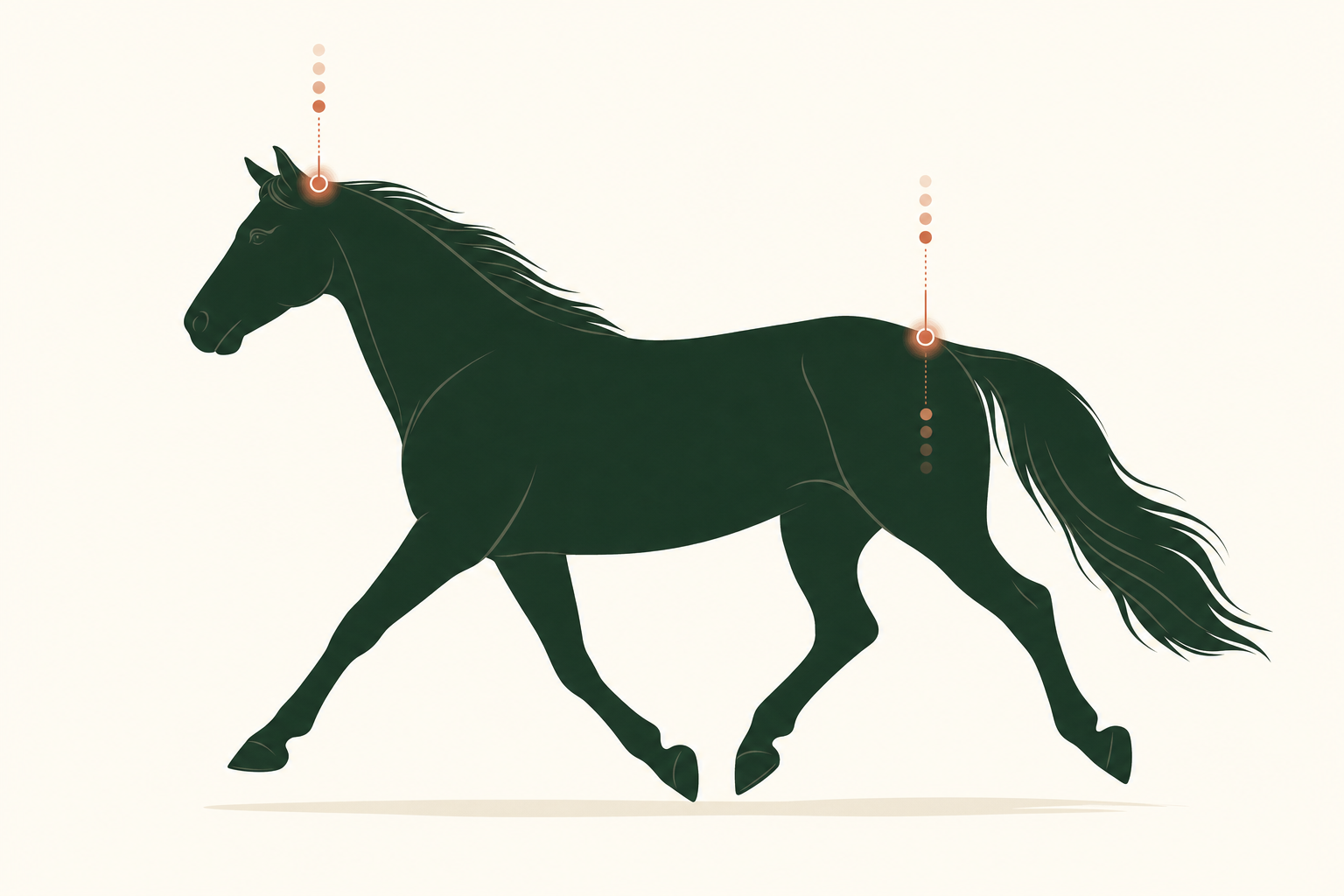
Core landmarks, two limb groups
Head nod signals forelimb. Hip hike signals hindlimb.
At a sound, symmetrical trot, a horse's poll and pelvis rise and fall in an even, repeating rhythm — each stride half mirrors the other. When a forelimb is uncomfortable, the horse typically raises its head more sharply as the sore leg lands, producing a lopsided "head nod." When a hindlimb is uncomfortable, one side of the pelvis rises more than the other during push-off, producing a "hip hike." Vets watch for exactly these two patterns during a trot-up exam — RideAlign measures them from video instead of by eye.
From video to a number
What happens after you tap Track Stride
Track the key points
Starting from where you tap poll, shoulder, elbow, hip, and both fore and hind hooves on frame one (plus a back point if the horse isn't tacked up, for topline tracking), RideAlign searches a small window around each point's previous position in every following frame and finds the best match — a classic template-matching technique, run entirely in a canvas in your browser.
Build motion curves
Each point's vertical (up/down) position over time becomes a curve. The curves are smoothed, then RideAlign finds the repeating stride cycle and splits every cycle into its two halves — one per pair of diagonal legs.
Compare the halves
RideAlign measures how much the two halves of each cycle differ at their peak and trough, averages that across every full cycle in the clip, and expresses it as a percentage of the point's total vertical travel — the Symmetry Index.
Compare to ideal
Your horse's actual curve for one representative stride is plotted next to a perfectly symmetric sine wave of the same frequency and amplitude, so you can see the asymmetry, not just a score.
Reading the score
Three bands, plainly worded
Looks symmetrical
Left/right movement is close to even. Keep an eye on it as part of normal monitoring.
Mild asymmetry — worth monitoring
A small but measurable difference between step halves. Re-screen in a week or two and watch the trend.
Notable asymmetry — recommend a vet exam
A clearer difference between step halves. This is a prompt to have a licensed vet take a look, not a diagnosis.
When the poll shows more asymmetry than the hip, RideAlign notes a pattern consistent with forelimb involvement; when the hip shows more, it notes a pattern consistent with hindlimb involvement. RideAlign never names a specific limb and never gives a diagnosis — only a licensed veterinarian can do that, with a hands-on exam.
Beyond symmetry
The Stride Strength Index
Symmetry only compares left vs. right. Stride Strength looks at rhythm instead: how consistent the timing between strides is (cadence), and how consistent the push-off amplitude is from one stride to the next. A horse with even, repeatable strides scores high; one with irregular timing or uneven push-off — which can reflect fatigue, mild discomfort, uneven footing, or an inconsistent gait — scores lower. It's a screening signal, not a fitness or strength diagnosis.
Strong, regular push-off rhythm
Cadence and amplitude are consistent from stride to stride.
Somewhat uneven rhythm — worth monitoring
A measurable amount of stride-to-stride variability.
Irregular rhythm — consider a vet or farrier check
Noticeable inconsistency in timing or push-off strength.
Beyond left-right symmetry
Shoulder Freedom, Stride Reach, and Topline Symmetry
Tracking the shoulder, elbow, and both hooves opens up a few more V1 pixel-geometry heuristics on top of the core head-nod/hip-hike Symmetry Index — none of them a validated biomechanical measurement, all of them a proxy computed from the same tapped points.
Shoulder Freedom
Tracks: how consistently the shoulder-to-elbow line sweeps forward and back each stride, from its angle relative to vertical.
Caveat: a sweep-regularity estimate, not a range-of-motion measurement — camera angle and gait speed both affect the reading.
Fore & Hind Stride Reach
Tracks: how consistently each hoof's horizontal swing distance repeats from stride to stride.
Caveat: a regularity estimate of reach, not an absolute stride-length measurement — it isn't calibrated to real-world distance.
Topline Symmetry
Tracks: left-right evenness of the back's vertical bob, using the same head-nod/hip-hike math applied to the back point — only available when the horse is filmed without a saddle.
Caveat: a screening signal only, most useful alongside the poll and hip readings rather than on its own.
The rider position module
Two camera angles, two sets of tracked points.
Riding instructors have long used the ear-shoulder-hip-heel line as a quick visual check of a rider's balance in the saddle. From a side-on clip, RideAlign tracks seven points — head, shoulder, elbow, hand, hip, knee, and foot — to measure how far that ear-shoulder-hip-heel line tilts from vertical on average (Alignment), how much it sways frame to frame (Stability), how steady the knee angle holds (Leg Position), and how soft and consistent the elbow and hand stay (Arm & Hand). From a front or back-on clip, RideAlign instead tracks five points — both shoulders, the head, and both hips — to measure Symmetry Score: how level the shoulders and hips stay, and how centered the head sits between the shoulders.
Reading the rider scores
Every rider score, in plain language
Well balanced / Steady
The ear/shoulder/hip/heel line stacks closely and holds steady through the clip.
Slight lean / Some wobble — worth a coach's eye
A measurable but modest amount of lean or sway.
Noticeable lean / Unsteady — consider a balance-focused lesson
A clearer amount of lean or sway worth addressing with a coach.
Alignment, Stability, Pelvic Tilt, Leg Position, Arm & Hand, and the three Symmetry Score readings (Shoulder, Hip, Head Centering) all share this same three-band scale. Every rider screening is saved to that rider's history, where you can pick any two past screenings and see the exact change between them — so you can track whether recent lessons or practice are actually moving the needle.
Meet the toolkit
What GaitTrace, SeatCheck, Symmetry Score, and Progress Tracker actually measure
These are our names for specific measurements inside RideAlign — not separate products, sensors, or medical devices. Every one of them is a proxy computed from the same tap-tracked video points described above, run through simple, published-style math. None of it is calibrated against clinical instruments, and none of it runs in true real time — every clip is analyzed frame by frame after you record it.
GaitTrace
Tracks: stride length, frequency, and ground-contact rhythm from the horse's poll, hip, shoulder, elbow, and hoof markers — including Shoulder Freedom and Fore/Hind Stride Reach.
Caveat: frame-rate and video quality directly affect precision — it's a rhythm-consistency estimate, not a force-plate measurement.
SeatCheck
Tracks: the ear-shoulder-hip-heel vertical line and how much it tilts or sways, plus — on side-on rider clips — Pelvic Tilt, Leg Position (knee angle), and Arm & Hand (elbow angle) steadiness.
Caveat: depends on a clean side-on camera angle; loose clothing or a partially blocked view can shift the marked points.
Symmetry Score
Tracks: left-to-right push-off comparison at the horse's poll, hip, and back to flag uneven loading; on front/back-on rider clips, tracks shoulder tilt, hip tilt, and head centering instead.
Caveat: a screening signal only — many non-lameness or non-position factors (footing, turns, camera angle) can also create asymmetry.
Progress Tracker
Tracks: every saved screening for a horse or rider, laid out as a multi-session heatmap and trendline.
Caveat: trends are only as reliable as the consistency of your filming setup session to session.
Honest about where we are
V1 today vs. what's on the roadmap
RideAlign V1 uses manual tap-to-mark tracking, on purpose. We'd rather ship something transparent and correct than overclaim an AI pose model we haven't built yet. Products like Sleip, RealHorse, Lameness Locator, and Ultralytics' Stride app point toward where automated pose tracking can go — that's Phase 2 for us, not a claim we make today.
V1 — today
- You tap each landmark point on frame one
- Template-matching tracks those points across frames
- Runs fully on-device, in your browser
- No pose model, no AI limb detection
Phase 2 — roadmap
- Automatic pose detection (no manual tapping)
- Additional landmarks (withers, croup, fetlocks)
- Multi-limb, multi-gait comparison
- Discipline scoring for Dressage — suspension time in the air
- Discipline scoring for Jumpers — scope of the jump
- Discipline scoring for Hunters — trot and canter rhythm
- Still a screening aid — never a replacement for a vet exam
RideAlign's horse gait module is a screening and monitoring aid, not a veterinary diagnosis. Always consult a licensed equine veterinarian to evaluate any suspected lameness before riding or working the horse. RideAlign's rider position module is a self-coaching aid, not a substitute for in-person instruction. Always work with a qualified riding coach or trainer to address position or safety concerns.